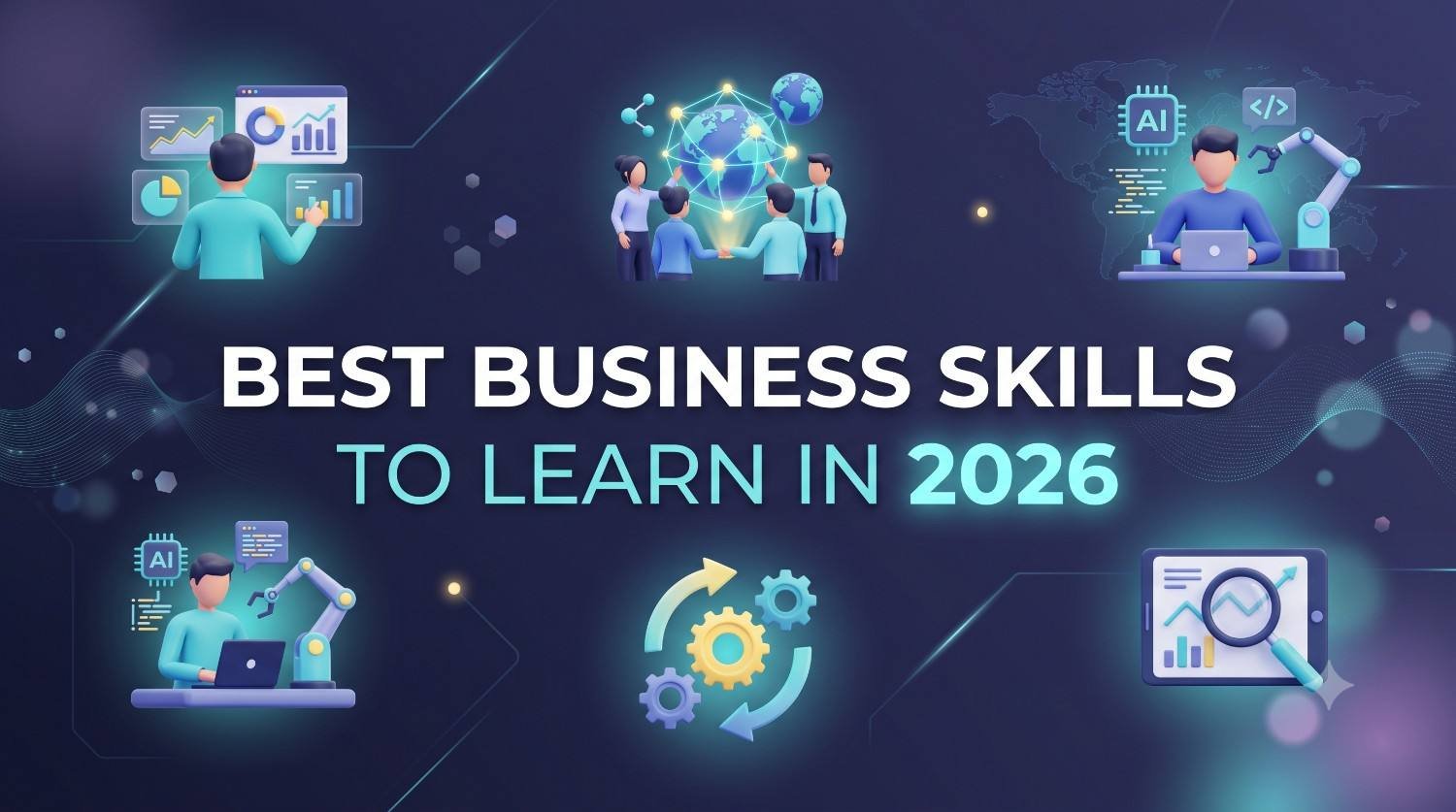
The job market is shifting fast. Having a degree or a stack of years at one company is not always enough anymore. Work is getting reshaped by AI. Buyers know more than they used to. Competition keeps getting tougher. In this environment, many firms want people who can choose well even when the facts are unclear. The World Economic Forum says employers think about 40% of main workplace skills will look different by 2030. It also notes that analytical thinking is still the core skill most employers look for.
The good part: you do not have to master every business topic. A better plan is to grow a set of business skills you can use in 2026. That set can help you learn what customers need, decide with less certainty, work with new tech, talk in a clear way, and show results you can measure. LinkedIn’s 2026 Skills on the Rise study points to more demand for work that spans teams. It also flags team leadership, clear updates for stakeholders, business growth efforts, go-to-market planning, AI planning for business, and governance. Risk work and compliance are also showing up more often.
Why these skills matter more in 2026
Many employers care more about what you can do than what your diploma says. They also care less about titles as proof of readiness. LinkedIn’s 2026 research says this shift is real, and employers are leaning harder toward usable skills. The World Economic Forum also lists skills that matter now and skills that are rising. On that list are analytical thinking, leadership and social influence, creative thinking, resilience, and tech know-how. It also includes talent work, plus AI and big data.
This creates an opportunity for professionals who can combine:
- Business knowledge.
- Technology awareness.
- Communication.
- Leadership.
- Analytical thinking.
- Customer understanding.
- Adaptability.
The best skills for moving up at work now often link different areas together, instead of staying in one lane.
1. Artificial Intelligence for Business
AI is turning into a key skill for many professionals. You do not have to be a machine-learning engineer to see how AI can help with day-to-day work, marketing, customer support, product research, or planning. What matters is being able to spot where AI can be helpful, and also knowing where it can fail or fall short.
Professionals should learn how to:
- Identify repetitive workflows.
- Evaluate AI use cases.
- Measure productivity gains.
- Assess AI risks.
- Create human-in-the-loop processes.
- Use AI responsibly.
LinkedIn’s 2026 research specifically identifies AI business strategy as an emerging area as companies integrate AI into products, services, and processes.
2. Strategic Thinking
Strategic thinking skills help you look beyond individual tasks and understand how decisions affect broader business objectives. Instead of asking only, “What should we do today?” strategic thinkers also ask, “Where are we trying to go, what could prevent us from getting there, and which actions create the greatest advantage?”
This skill is useful for entrepreneurs, managers, consultants, marketers, and employees who want to move into leadership.
Develop it by studying:
- Competitive positioning.
- Market trends.
- Business models.
- Long-term planning.
- Resource allocation.
- Scenario analysis.
Turning busy work into a clear direction takes strategy.
3. Analytical thinking
Analytical thinking is still one of the key skills people need at work. The World Economic Forum study for 2025 puts it at the top. It says 69% of surveyed employers call it necessary.
Good analysts do more than gather facts. They decide what is relevant. They spot trends. They question their own assumptions. Then they choose what to do next, using what the evidence shows .
You can strengthen this ability by:
- Breaking complex problems into smaller parts.
- Comparing alternatives.
- Questioning assumptions.
- Studying business data.
- Looking for root causes.
In a world full of AI-made content, it helps to judge what you read before you trust it.
4. Communication Skills
Strong communication can speed up nearly any job path. Even a smart technical idea does not go far if you cannot describe it in a clear way to coworkers, clients, leaders, or backers.
Good communication is not only about sending tidy emails. It also covers talks in meetings, planning and presenting ideas, handling talks with other parties, sending updates to the right people, writing different kinds of summaries, and having clear, convincing discussions.
Focus on:
- Clear writing.
- Confident speaking.
- Active listening.
- Concise presentations.
- Executive communication.
- Storytelling.
LinkedIn says executive and stakeholder communication matters more in 2026. It also points to public speaking and teamwork across departments.
5. Leadership and People Management
You do not have to hold a manager title to grow leadership skills. At its core, leadership means helping others get closer to a goal you both agree on.
A strong leader sets clear expectations. They give useful feedback. They help settle conflicts. They work to build trust. They also make calls even when all the facts are not available. The World Economic Forum lists leadership and social influence as key skills that employers value right now..
Develop your leadership ability by practicing:
- Delegation.
- Coaching.
- Feedback.
- Conflict resolution.
- Decision-making.
- Team motivation.
Strong leadership is increasingly about creating clarity rather than simply giving instructions.
6. Sales and Business Development
A company cannot run without customers, partners, or other stakeholders. Because of that, business development skills work well in many fields. It is not just about getting someone to say yes and sign a deal. Today’s sales is about listening to what a customer is dealing with, spotting the right openings, explaining why your solution matters, earning confidence, and staying in touch over time.
LinkedIn says its 2026 research points to business development and go-to-market work as skills that are climbing in importance for growing revenue and business.
Even professionals who do not work in sales can benefit from understanding:
- Customer needs.
- Value propositions.
- Lead generation.
- Relationship building.
- Negotiation.
- Pipeline management.
7. Negotiation
Negotiation helps in more places than just closing deals. People use it to talk about pay, due dates, money for work, contract terms, new partnerships, job duties, and what comes first.
A strong negotiation is not about pushing someone into your way. It is about listening to what they care about and working out an agreement that helps both sides, without giving up what you must have.
Practice by learning to:
- Prepare before discussions.
- Identify your alternatives.
- Ask better questions.
- Listen carefully.
- Separate people from problems.
- Focus on interests rather than positions.
As people step into management and roles that deal with clients, negotiation starts to matter a lot more.
8. Financial literacy
You do not have to study accounting to build financial literacy. Still, when you grasp how money flows through a company, your choices get sharper.
Learn the basics of:
- Revenue.
- Costs.
- Profit margins.
- Cash flow.
- Budgeting.
- Return on investment.
- Financial statements.
A marketing manager who knows CAC can pick campaigns with more care. A founder who tracks cash flow can scale without rushing. When people get the basics of money, they stop guessing and start choosing with clearer info.
9. Data skills
More companies use numbers every day. They look at customer patterns, check how things are going, predict what might happen next, and judge results. Because of that, data skills matter for many roles, not only for data scientists. You should be able to read charts and common stats like percentages, trends, averages, and conversion rates, plus the main business metrics.
Learn how to distinguish:
- Correlation from causation.
- Useful metrics from vanity metrics.
- Short-term changes from long-term trends.
- Reliable data from misleading data.
Data literacy helps professionals ask better questions before making decisions.
10. Digital Marketing
Customer behavior continues to shift across search engines, social platforms, email, websites, marketplaces, communities, and AI-powered discovery tools. That makes digital marketing skills valuable for entrepreneurs and professionals across industries.
Learn the fundamentals of:
- SEO.
- Content marketing.
- Email marketing.
- Social media.
- Paid advertising.
- Conversion optimization.
- Analytics.
You do not need to specialize in every channel. Understanding how different channels work together can help you create stronger customer acquisition strategies.
11. Customer Experience
Businesses can copy products, pricing structures, and features. Creating an excellent customer experience is harder.
Customer experience skills involve understanding what customers need before, during, and after a purchase.
Look at the entire journey:
Discovery → Consideration → Purchase → Onboarding → Support → Retention
At each stage, ask where customers experience friction.
That is useful right now because expectations keep going up. People are used to quick, tailored digital services, so they notice when a product feels slow or generic.
12. Product Management
Product management lives between customers, company goals, tech, and delivery. A product manager has to sort out what people actually need. They also decide which issues matter most. Then they set what to do first, and they track whether the results match what the team wanted.
Important capabilities include:
- Customer research.
- Product strategy.
- Roadmapping.
- Prioritization.
- User stories.
- Experimentation.
- Product analytics.
If you are not aiming for a product-management role, these ideas still help you think about value in a clearer way.
13. Project management
Plenty of companies spot a good idea, then lose steam when it is time to ship. Project management helps you move from a plan to a finished result.
A strong project manager sets clear goals. They line up the people and tools needed. They watch the schedule, flag problems early, and keep the group moving. They also update the people who care about progress.
Learn fundamentals such as:
- Scope management.
- Scheduling.
- Resource planning.
- Risk management.
- Stakeholder communication.
- Progress tracking.
Tools can help, but successful project management depends heavily on communication and judgment.
14. Adaptability and Resilience
The ability to adapt is increasingly important because business conditions can change quickly. New technologies, regulations, competitors, economic pressures, and customer expectations can make yesterday’s strategy less effective.
The World Economic Forum lists resilience, flexibility, and agility among the most important current core skills and among capabilities expected to remain highly relevant.
Adaptability skills involve:
- Learning quickly.
- Adjusting plans.
- Accepting feedback.
- Remaining effective during uncertainty.
- Recovering from setbacks.
Adaptability is not about turning around every time. It is about noticing when the facts point to a new path.
15. Creative Problem-Solving
Automation can take care of many repeated tasks. Still, companies meet issues with no clear solution from the start. Creative problem-solving lets people come up with options when the usual method fails. Don’t rush to pick the one “correct” answer. Try a few different routes first.
Useful techniques include:
- Brainstorming.
- Root-cause analysis.
- Design thinking.
- Scenario planning.
- Experimentation.
- Reverse thinking.
The World Economic Forum identifies creative thinking as one of the important skills expected to increase in relevance through 2030.
16. Networking and Relationship Building
Opportunities often emerge through relationships. Strong business networking skills can help professionals discover partnerships, clients, mentors, opportunities, and useful knowledge. Effective networking is not about collecting hundreds of contacts.
Focus on:
- Giving value.
- Following up.
- Asking thoughtful questions.
- Sharing useful information.
- Maintaining genuine relationships.
LinkedIn’s 2026 research emphasizes collaboration, mentorship, stakeholder communication, and people management as increasingly important areas.
17. Risk Management
Businesses operate under uncertainty. Risk management skills help organizations identify potential problems before they become expensive failures.
Risks can involve:
- Finance.
- Cybersecurity.
- Regulation.
- Operations.
- Reputation.
- Supply chains.
- Technology.
LinkedIn points to governance, risk, and compliance as fast growing priorities. Companies are dealing with tougher rules, plus higher pressure on security and money matters. The aim is not to wipe out every possible problem. That would not be realistic. Instead, the focus is on spotting the risks that actually matter, judging how much harm they could cause, and choosing reasonable next steps.
18. Business Technology Literacy
You do not have to code to be tech aware. Being tech literate for business means you can understand the basics of AI, cloud systems, cybersecurity, automation, data, and other digital tools. With that knowledge, you can make better business calls. This matters even more for managers. Tech choices can come with large budgets and real day to day effects.
Learn the fundamentals and understand how technology can support:
- Efficiency.
- Customer experience.
- Data analysis.
- Automation.
- Security.
- Product development.
The World Economic Forum lists technological literacy among the fastest-growing skill areas.
19. AI-Powered Productivity
AI can become a powerful productivity assistant when used thoughtfully. AI productivity skills include knowing how to research, summarize, brainstorm, analyze, draft, automate, and organize work with AI tools while maintaining appropriate human oversight.
For example, professionals can use AI to:
- Summarize long documents.
- Generate first drafts.
- Analyze structured information.
- Prepare meeting notes.
- Create research frameworks.
- Automate repetitive workflows.
The key point is that AI should help you make better calls, not take over your decisions.
20. Continuous learning
One of the biggest business skills for the coming years is the ability to keep learning. What matters in your work today can look very different in just a short time.
The World Economic Forum points to curiosity and learning over a lifetime as two areas likely to matter more.
Create a simple learning system:
- Choose one skill.
- Learn the fundamentals.
- Practice it on a real business problem.
- Measure your results.
- Ask for feedback.
- Improve and repeat.
This approach creates practical capability rather than passive knowledge.
Best Business Skills for Different Career Goals
Not every professional needs the same combination of skills. Your ideal learning path should depend on where you want your career to go.
| Career Goal | Skills to Prioritize |
| Entrepreneur | Sales, finance, strategy, AI, marketing |
| Manager | Leadership, communication, project management |
| Marketer | Digital marketing, analytics, customer experience |
| Sales Professional | Negotiation, communication, business development |
| Consultant | Analytical thinking, strategy, communication |
| Product Professional | Product management, analytics, customer research |
| Freelancer | Sales, personal branding, finance, communication |
| Business Analyst | Data literacy, analytics, problem-solving |
| Executive | Strategy, leadership, financial literacy, AI |
This makes business skills to learn in 2026 a personal decision rather than a universal checklist.
How to Learn Business Skills Faster
Reading about a skill is only the beginning. The fastest improvement usually comes from applying knowledge to real situations.
For example, if you are learning negotiation, practice negotiating a realistic scenario. If you are learning financial literacy, analyze a company’s publicly available financial statements. If you are learning marketing, create a small campaign and measure its performance.
Use this cycle:
Learn → Apply → Measure → Get Feedback → Improve.
Projects create evidence that you can actually use a skill.
Certifications vs Practical Business Skills
Certifications can demonstrate structured learning, but they should not become the final goal. A certificate may show that you completed a course; a portfolio, business project, case study, or measurable result can demonstrate what you can actually do.
Consider creating:
- Business case studies.
- Marketing experiments.
- Financial analyses.
- Strategy presentations.
- Sales projects.
- Process-improvement examples.
- AI workflow demonstrations.
LinkedIn’s 2026 research points toward employers increasingly emphasizing skills over traditional credentials alone.
The Best Combination of Business Skills in 2026
The strongest professionals will combine multiple capabilities instead of relying on one isolated skill.
For example:
AI + Analytics + Strategy can help professionals make smarter technology-driven decisions.
Sales + Negotiation + Communication can create a powerful revenue-focused skill set.
Leadership + Project Management + Financial Literacy can prepare professionals for management.
Marketing + Customer Experience + Data can strengthen customer acquisition and retention.
This combination approach creates future-ready business skills because it connects knowledge to measurable outcomes.
Conclusion
In 2026, the most useful business skills come from a mix of judgment, business know how, tech awareness, and the skill to follow through. People also need strategic thinking, solid analysis, leadership, and clear communication. Along with that, business development, negotiation, and a basic grasp of finance matter. Data literacy and digital marketing are also important for many roles. Project management helps work stay organized. For some jobs, an understanding of AI business strategy is now expected. Finally, adaptability keeps you steady when rules change. Recent work cited by the World Economic Forum highlights skills like analytical thinking, leadership, creative thinking, resilience, technology literacy, and AI related knowledge. LinkedIn’s 2026 figures point to growing needs in business development, talking with stakeholders, teamwork, AI strategy, and risk management. Instead of trying to learn everything at once, pick two or three skills that fit where you want to go. Put them to use in real tasks and real projects. Keep revisiting your plan as markets shift and new tools show up.
Frequently Asked Questions
1. What are the best business skills to learn in 2026?
Strategic thinking, AI business strategy, communication, leadership, sales, financial literacy, data literacy, and adaptability are strong choices based on current employer trends.
2. Which business skill is most important for career growth?
Analytical thinking is a strong foundation because it helps professionals solve problems, evaluate information, and make better decisions. The World Economic Forum ranks it as the leading core skill in its latest research.
3. Should business professionals learn AI?
Yes. Understanding how AI can support business processes, decision-making, productivity, and strategy is becoming increasingly valuable across industries.
4. Are soft skills still important in 2026?
Absolutely. Leadership, communication, collaboration, resilience, and creative thinking remain highly relevant even as technology skills become more important.
5. How can I learn business skills quickly?
Choose one skill, study the fundamentals, apply it to a real business problem, measure the outcome, and improve through feedback. Practical application is more useful than simply collecting courses or certificates.