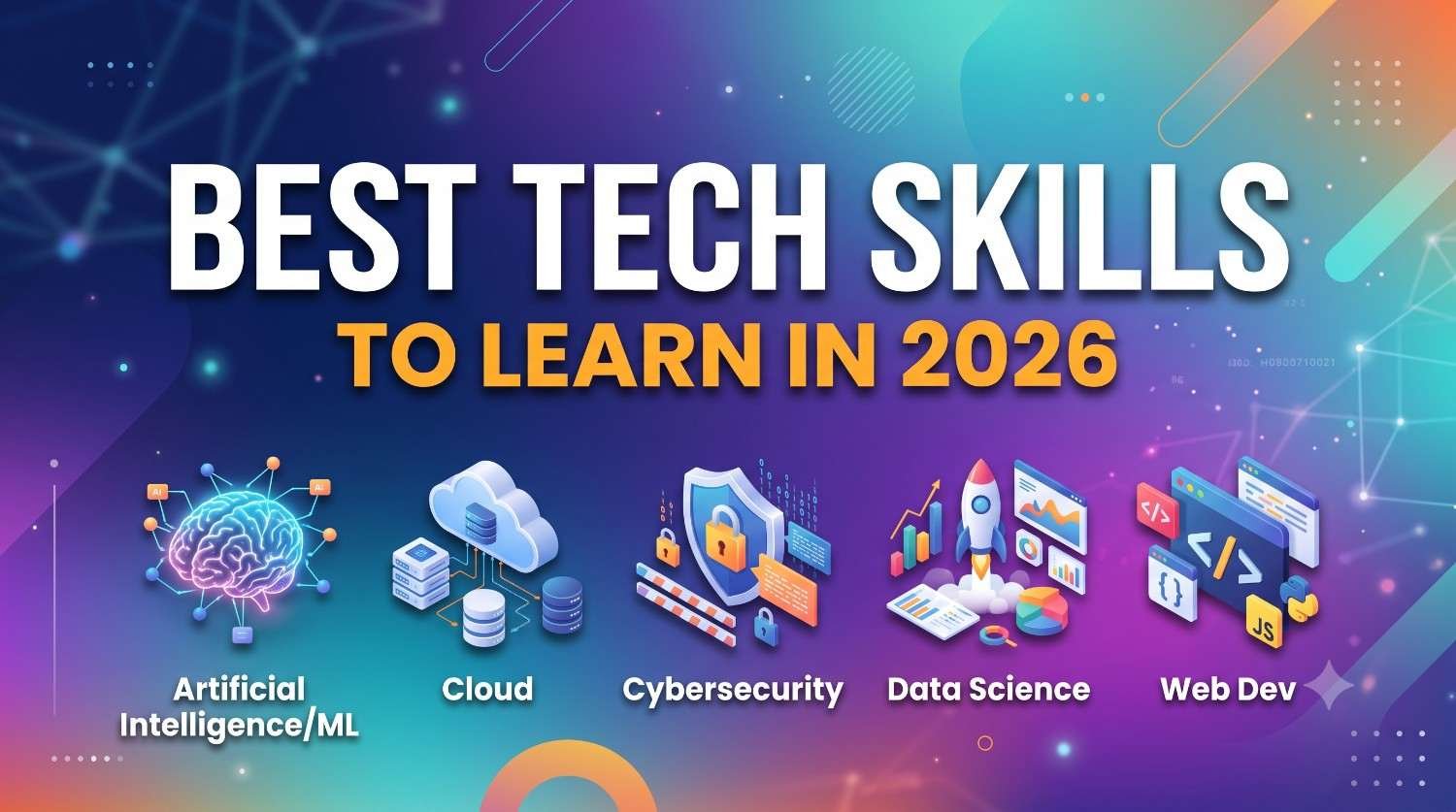
Technology is changing faster than a lot of professionals can keep up with , when it comes to their resumes. Things that used to seem pretty niche and specialized are now becoming everyday business requirements, and meanwhile artificial intelligence is shifting the way software gets built, how data is interpreted, systems are secured, and even how decisions are made. The World Economic Forum notes that AI and big data, networks and cybersecurity, plus technological literacy are among the fastest growing skill areas all the way through 2030. They also estimate that about 39% of workers’ current skill sets could be reshaped or turn outdated somewhere between 2025 and 2030.
But this doesn’t mean you have to chase every new tool or technology that pops up. Honestly, if you try to master everything, you might end up being sort of aware of many instruments, but not genuinely strong at any one thing. A smarter move is to build a mix of future tech skills, solid fundamentals, real project experience, and the human side stuff like analytical thinking and communication. LinkedIn’s 2026 Skills on the Rise research points in a similar direction, it calls out AI related abilities like prompt engineering and large language models, but it also stresses that employers are increasingly looking at what people can actually perform, rather than just degrees, or job titles .
Why Tech Skills Matter More in 2026
The tech job market is getting more skills focused, less about buzzwords. Employers are trying to find people who can apply technology to solve business problems, automate repetitive tasks, safeguard information, make sense of data, and build products that actually help. The World Economic Forum’s latest Future of Jobs research says technological skills are expected to climb in importance quicker than any other broad skill group, with AI and big data leading the pack, then networks and cybersecurity, and technological literacy.
For professionals, this creates an important opportunity:
- Build practical skills rather than collecting certificates.
- Learn technologies that solve real problems.
- Combine technical knowledge with communication.
- Keep updating your skills as tools evolve.
1. Artificial Intelligence and Generative AI
Artificial intelligence skills are arguably, some of the most valuable capabilities to build in 2026. AI isn’t really stuck in research labs anymore or inside a handful of specialist technology companies. Businesses are already using AI for customer service, content production , coding support, data analysis, projection, promotional tasks, document handling, and the sort of workflow automation that makes everyday work feel smoother. Learning AI doesn’t always translate into becoming a machine-learning researcher. A lot of professionals can still gain a whole lot by really understanding how generative AI behaves, how to assess what it produces, how to craft practical workflows, and where human judgment is still absolutely crucial, even when the model sounds confident.
Useful areas to explore include:
- Generative AI fundamentals.
- Large language models.
- AI workflow design.
- AI evaluation.
- Responsible AI.
- AI automation.
LinkedIn’s 2026 research specifically points to prompt engineering and large language models as among the rising technical, and strategic AI skills.
2. Prompt Engineering
Prompt engineering has kind of moved from a niche idea to a real day to day workplace ability. In practice it’s about shaping lucid instructions , and workflows that guide AI systems to deliver useful outcomes, reliable answers, and results that actually fit the surrounding context. But effective prompting isn’t just about tossing together a clever sentence or two. Strong practitioners really get the goal, add meaningful background, set boundaries , then they check what comes back and revise the back and forth based on what they see.
For instance , a marketer could use structured prompts to interpret customer feedback, while a developer might ask AI to explain a piece of code or even produce test cases. So the most valuable AI productivity skills usually mix prompting with critical review. Because if you can’t spot a wrong AI answer , then a polished prompt by itself probably won’t fix anything.
3. Data Analytics
Companies create huge amounts of information, yet raw data on its own is basically useless without interpretation. Data analytics skills help people turn numbers into actionable insights. Learning analytics can also unlock roles and opportunities across marketing, finance, operations, product management, healthcare, retail and a lot of other sectors.
A strong learning path can include:
- Excel or spreadsheet analysis.
- SQL.
- Data visualization.
- Basic statistics.
- Dashboard creation.
- Business intelligence.
You do not have to become some full data scientist just to take advantage of data. If you can grasp how to ask good questions, clean the information, spot the underlying trends and then share what you found, you end up being far more valuable in almost any job, even if it is not about analytics every day.
4. Python Programming
Python is still one of the most useful programming languages for people stepping into tech, because it shows up everywhere in automation, data analysis, AI, machine learning, web development, and scripting. Having Python skills can feel especially strong when it is paired with another direction, like Python plus data analytics gives you a more specific career trajectory than Python plus cybersecurity , and that difference can matter. Beginners should not try to memorize the entire language up front, instead start with a smaller set of tasks and build from there.
Focus instead on fundamentals:
- Variables and data types.
- Functions.
- Loops.
- Conditional logic.
- File handling.
- APIs.
- Basic libraries.
Then go for little projects. Build something small ,like a script that actually fixes a real headache. Honestly, writing a program that addresses a practical problem is often much more useful than finishing a bunch of unrelated tutorials.
5. Cybersecurity
As companies become more digital, protecting systems identities, applications, and information keeps getting more critical. The World Economic Forum puts networks and cybersecurity among the fastest growing skill areas up through 2030. If you build up your cybersecurity skills, you can move into careers like security analysis, cloud defense, penetration testing, identity management, governance, risk and compliance ,and also security engineering, not just one lane but several paths at once.
Beginners should first understand fundamentals such as:
- Networking.
- Operating systems.
- Authentication.
- Access control.
- Encryption.
- Security monitoring.
- Common attack methods.
Cybersecurity isn’t just about breaking in , or hacking as people like to say. In practice modern security folks need to grasp how technology blends with people, and how processes and business risks end up talking to each other.
6. Cloud Computing
Nowadays a lot of applications lean on cloud infrastructure. So cloud computing know-how becomes handy for developers, IT professionals, people working with data, security engineers, and even technical project managers. Honestly the big ideas matter more than trying to memorize hundreds of cloud services, because the patterns repeat, and you’ll figure out the rest from there.
Start by understanding:
- Virtual machines.
- Storage.
- Databases.
- Networking.
- Identity and access management.
- Containers.
- Serverless computing.
- Cloud security.
Once the basics are clear, you can lean into specialization on platforms like AWS , Microsoft Azure , or Google Cloud. The point is, not only to know the names, but to understand how cloud systems really run, and how organizations actually use them not just to go collect a bunch of cloud certifications.
7. DevOps and Automation
Companies want software shipped faster , and they want the systems handled more efficiently. DevOps skills bring together development, operations , automation, observability, and teamwork. When you learn DevOps, you get a clearer picture of how software flows from development into production, like a smooth relay, not a random handoff.
Important areas include:
- Git.
- CI/CD.
- Containers.
- Infrastructure as code.
- Monitoring.
- Automated testing.
- Deployment workflows.
Automation is really valuable because it takes away a lot of that repetitive manual stuff. The mix of cloud services, automation, and security is getting more and more important as the whole tech infrastructure becomes more complex, and honestly it tends to grow faster than people expect.
8. SQL and Database Management
You can build, or use advanced AI tools and very polished dashboards, but if you can’t handle structured data then your choices stay pretty narrow. So SQL skills are still highly practical , like, in a day to day sense. With SQL, professionals can retrieve information, filter it, connect tables with joins, aggregate results, and analyze what’s stored in relational databases.
It is useful for:
- Data analysts.
- Software developers.
- Business analysts.
- Product managers.
- Marketing professionals.
- Data scientists.
SQL is also kinda approachable compared with a bunch of programming languages, which makes it a solid tech skill to start with, honestly.
9. Machine Learning
Machine learning skills are valuable for professionals who want to build systems that can learn patterns from data. Machine learning tends to sit underneath a lot of recommendation engines, prediction systems, fraud-detection tools, computer vision apps, and also wider AI products .
A beginner should understand:
- Supervised learning.
- Unsupervised learning.
- Training and testing data.
- Model evaluation.
- Feature engineering.
- Overfitting.
- Basic statistics.
You do not need to start with advanced mathematics right away. First build your mental base, then slowly pick up the math and the engineering depth you’ll need for actual professional work, you know.
10. Data Engineering
AI and analytics really rely on dependable data. Data engineering is about gathering, changing, storing, and delivering data so that people doing analysis and AI systems can finally use it. This area gets even more important when companies start to build more and more tangled data environments, kind of like a web that keeps growing.
Key areas include:
- Data pipelines.
- ETL and ELT.
- Databases.
- Data warehouses.
- Data lakes.
- APIs.
- Cloud infrastructure.
- Data quality.
A strong data engineer is not only shuttling information from one place to another. They end up building trustworthy infrastructure that lets organizations actually rely on their data, like , without constantly second guessing it.
11. AI Automation and agentic workflows
One of the most interesting emerging tech skills in 2026 is being able to tie AI models together with tools, APIs, business systems, and automated workflows. Instead of using AI just as a chatbot, professionals can craft setups where AI helps with multi step processes and the whole flow feels smoother, more coordinated.
For example, an automated workflow might:
- Receive a customer request.
- Classify the issue.
- Retrieve relevant information.
- Draft a response.
- Escalate complex cases.
- Record the outcome.
The important skill is not just knowing one AI product. It’s kinda understanding how the whole workflow works, along with the related things like APIs, permissions, evaluation, and also that human oversight part.
12. UX and product design
Technology only really matters when people can actually use it. That is why UX design skills stay valuable, even as AI keeps shifting the tech landscape. UX professionals look at how users interact with products and they figure out ways to make the experience clearer, faster,and more intuitive.
Important concepts include:
- User research.
- Information architecture.
- Wireframing.
- Prototyping.
- Usability testing.
- Accessibility.
- Interaction design.
AI may accelerate design tasks, but understanding users and making good product decisions still requires human judgment.
13. API Integration
Modern software rarely operates alone. Applications communicate with payment systems, databases, AI models, analytics platforms, customer-management tools, and other services through APIs. Learning API integration skills can therefore make you useful across development and automation projects.
You should understand concepts such as:
- REST APIs.
- HTTP requests.
- Authentication.
- JSON.
- API keys.
- Webhooks.
- Error handling.
Even non-developers can benefit from understanding how APIs connect digital tools.
14. Blockchain and Web3 Fundamentals
Blockchain isn’t this universal fix for every technology issue anymore, yet knowing how the architecture works still matters a lot for people in financial technology, digital assets, decentralized apps, and the new wave of digital infrastructure. It’s one of those things you may not use daily, but you understand it so you don’t get blindsided later.
When people say “blockchain skills” they could mean distributed ledger systems, smart contract logic, consensus procedures , tokenization approaches, plus blockchain security practices. Instead of learning it on autopilot, the smarter path is to study it in a critical way. Try to see where it actually produces real leverage and where a traditional database might be the better tool, even more straightforward in certain cases.
15. Quantum Computing Awareness
Quantum computing is still a developing area , not something every professional must master right now. Even so, quantum computing knowledge could become more and more useful for those working in advanced computing, cryptography, scientific investigations, and niche specialized technology. If you’re just starting, you can begin with core ideas and mental models, rather than jumping straight into complex quantum programming , or whatever the most technical projects sound like.
Understand:
- Qubits.
- Quantum gates.
- Superposition.
- Entanglement.
- Quantum algorithms.
- Potential applications.
This gives you enough context to see where the technology might fit in the future, without you having to dive in right away, or do a proper immediate specialization.
16. Technology Literacy
You really do not need to become a programmer to gain from technology. Technology literacy is basically knowing how digital systems tick, enough to use them well, and also choose wisely when decisions come up. The World Economic Forum ranks technological literacy among the fastest-growing skill areas, right there with AI and big data, networks, and cybersecurity.
Technology literacy can help professionals:
- Evaluate new software.
- Understand cybersecurity risks.
- Work with technical teams.
- Automate simple processes.
- Make better technology decisions.
It is increasingly becoming a baseline professional skill rather than a niche capability.
17. Analytical Thinking
Technical knowledge gets way more valuable once it’s paired with analytical thinking skills. Like yeah you might know how to use an AI tool, but do you really have the ability to decide if what it suggests actually makes sense? Analytical thinking lets you slice complicated situations into smaller parts, weigh the evidence, trade off options, and spot patterns. The World Economic Forum also lists analytical thinking as one of the key skills expected to grow in importance by 2030, so that’s part of why technical skill and human skill shouldn’t be treated like they compete with each other.
18. AI Governance and Responsible Technology
Since AI is getting built into everyday business processes, organizations now need professionals who understand privacy, security, bias, transparency, accountability, and responsible deployment. Responsible AI skills can be especially useful for people in technology leadership, compliance, cybersecurity, product development, and enterprise AI .
You should understand:
- Data privacy.
- Model limitations.
- AI security.
- Bias and fairness.
- Human oversight.
- Governance frameworks.
- Risk assessment.
This area will become more important as companies move from AI experiments toward production systems.
19. Communication for Tech Professionals
Technical ability by itself doesn’t really lock in career success. You also need to explain tricky ideas to people who don’t really have a technical background, like at all. Tech communication talent helps devs lay out architecture, analysts share meaningfully, security squads communicate risks, and product people make sure the technical side and business side don’t clash. So you practice writing in a clear way, you present stuff, you keep documentation, and you ask exact questions.
LinkedIn 2026 skills research also points out that communication, cooperation, leadership, and other people skills are getting more and more important along with pure technical capacity.
20. Continuous Learning
Maybe the most crucial competence to build in 2026 is staying able to learn continuously. Tech moves too fast for anyone to think that one single qualification will cover everything for a full career span. The World Economic Forum notes that curiosity, and lifelong learning, are expected to rise in importance.
A strong technology learning strategy could include:
- Following reliable technology publications.
- Building small projects.
- Taking focused courses.
- Reading technical documentation.
- Joining professional communities.
- Reviewing your skill gaps regularly.
Your goal should not be to chase every trend. Instead, learn how to sort through which ones actually matter to your career and then build hands on competence that sticks, not just theory.
Which Tech Skills Should Beginners Learn First?
If you are starting from scratch then learning everything at once can become quickly overwhelming . A better move is to set up a foundation first, and only after that, choose a specialization.
A beginner-friendly path could look like this:
| Stage | Skills to Focus On | Main Goal |
| 1 | Technology literacy | Understand digital systems |
| 2 | AI fundamentals | Use AI effectively |
| 3 | Data basics | Understand information and analytics |
| 4 | SQL or Python | Build technical foundations |
| 5 | Cloud fundamentals | Understand modern infrastructure |
| 6 | Cybersecurity basics | Develop security awareness |
| 7 | Specialization | Build job-ready expertise |
| 8 | Projects | Demonstrate practical ability |
This approach creates job-ready tech capability rather than a pile of random certificates that really don’t connect.
How to pick the right tech skill
The best skill for you kinda depends on what you’ve already done and where you want to go. If you enjoy numbers and patterns, then data analytics, or even machine learning might be the right direction. If you like constructing systems , programming cloud computing and DevOps could fit you. If you’re more into troubleshooting and risk analysis, cybersecurity may be a very solid option.
Ask yourself:
- What type of work do I enjoy?
- What skills do I already have?
- What industries interest me?
- Do I prefer building, analyzing, designing, or managing?
- Can I practice the skill through real projects?
The most valuable tech skills for career growth aren’t always the trendiest ones. It’s more like the things you can actually sink your teeth into and then keep applying, day after day, without dropping the ball.
How to pick up tech skills in a quicker way
If you just watch tutorials for months, and you don’t really build anything, it can give you this false sense of motion. A smarter plan is to mix studying with hands-on practice, like, right away, so the learning sticks and turns into usable results.
Use a simple cycle:
Learn → Practice → Build → Review → Improve.
For example, after you learn Python basics, make a small expense tracker, even if it’s kind of basic. After learning SQL, do a deep dive into a public dataset. After APIs, connect two simple services , and test the whole thing end to end. Projects give you proof that you can genuinely use the skill in the real world and not just read about it.
Certifications vs Practical Skills
Certifications can show structured learning, especially in cloud computing and cybersecurity , but still , having a certificate by itself does not automatically mean you’ll handle real-world problems. Build a portfolio while you collect credentials, because that combination is what makes the evidence feel solid and less theoretical.
A strong portfolio might include:
- GitHub projects.
- Data dashboards.
- Automation workflows.
- Technical articles.
- AI prototypes.
- Security labs.
- Cloud projects.
Employers are increasingly going after skills you can actually show, and LinkedIn’s 2026 research seems to point toward a wider move away from titles and toward skills based judgement, or so it feels.
The Best Combination of Skills for 2026
The strongest professionals probably won’t lean on just one lone technology. They will more often braid together complementary capabilities and related strengths, kinda like a practical set, not a single gadget.
For example:
AI + Data + Python can create a strong analytics and automation profile.
Cloud + Cybersecurity + DevOps can create a powerful infrastructure profile.
AI + UX + Product Management can support intelligent digital product development.
Technology, communication and business strategy can help train professionals for technical leadership, kind of preparing you for it in a more grounded way. It also builds a future ready tech career, because it ties what you can do technically with real business value— not just theory.
Conclusion
The best tech skills to learn in 2026 are not stuck inside one programming language, or only a trendy platform. Artificial intelligence, data analytics, cybersecurity, cloud computing, Python, machine learning, automation, DevOps, technology literacy, and analytical thinking all work as solid base skills, and then things like AI governance, agentic workflows, quantum computing, plus API integration can open the door to deeper specialization. According to current research from the World Economic Forum and LinkedIn, tech skills are increasing fast, but human strengths like analytical thinking, communication, adaptability, teamwork, and lifelong learning are still crucial. So the smartest route is basically this: pick one core technical track, build hands-on projects, add complementary skills, and keep learning as the tools and trends keep changing. You do not have to master every new utility in 2026, you just need to become extremely useful at fixing real problems with technology.
Frequently Asked Questions
1. What are the best tech skills to learn in 2026?
AI, data analytics, cybersecurity, cloud computing, programming, automation, and technological literacy are among the strongest areas to consider based on current employer and labor-market research.
2. Which tech skill is easiest to learn for beginners?
Technology literacy, basic AI use, SQL, and introductory Python are approachable starting points, especially when learned through practical projects.
3. Is AI a good skill to learn in 2026?
Yes. AI and big data are among the fastest-growing skill areas identified by the World Economic Forum, while LinkedIn’s 2026 research also highlights growing demand for AI-related capabilities.
4. Should I learn coding or AI first?
Learning basic coding alongside AI can be useful, but you do not need advanced programming before exploring AI. Choose based on your career goal and gradually combine the two.
5. How can I become job-ready in technology?
Choose one specialization, learn its fundamentals, build several practical projects, document your work, and develop communication and problem-solving skills alongside technical knowledge.