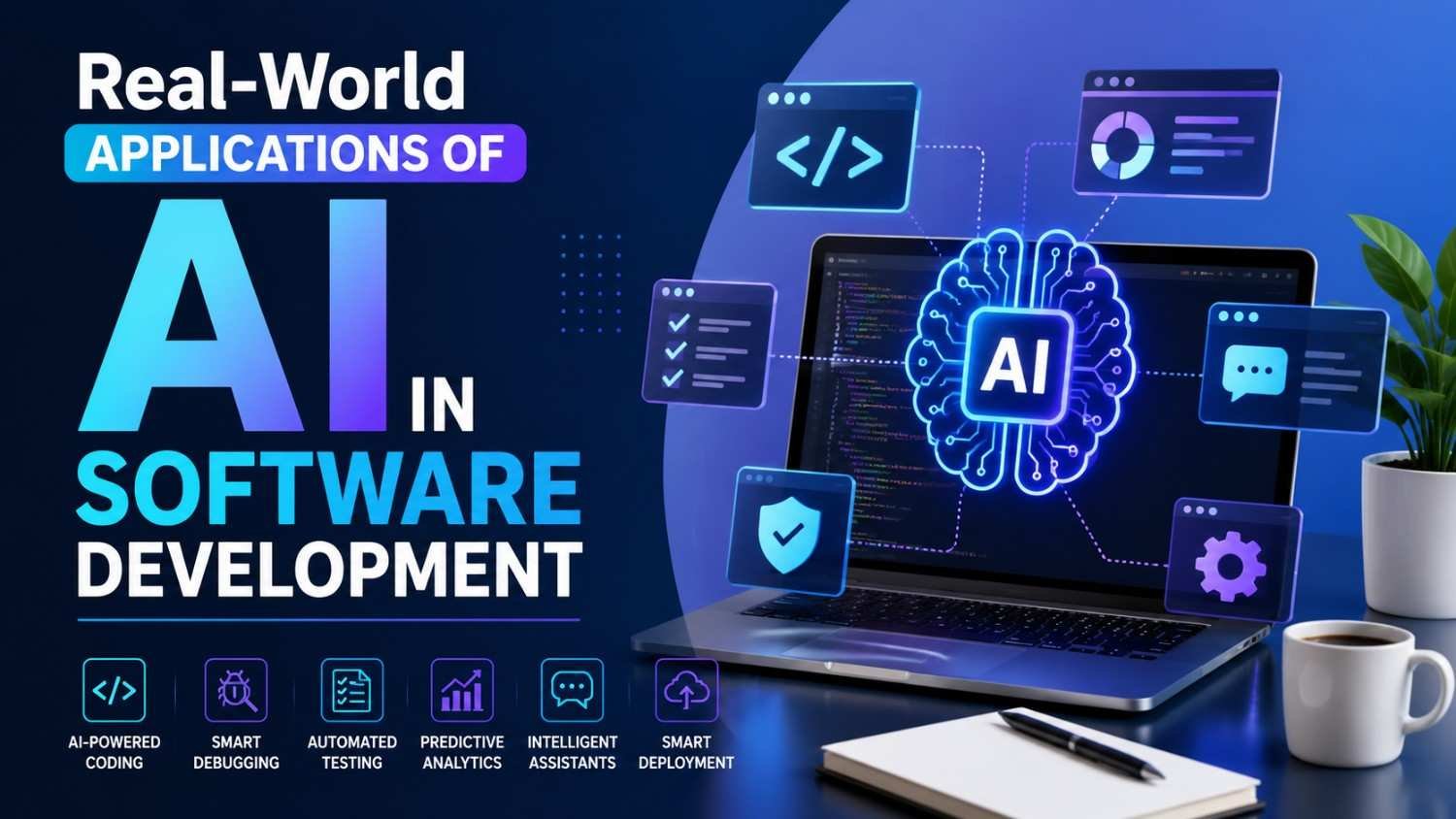
Artificial Intelligence (AI) is no longer this kind of far future idea only for research labs or massive technology companies. Today AI has become a core part of modern software development, and honestly it helps developers write code faster, automate those repetitive chores, improve decision making, and even design smarter applications. Lots of businesses across different industries are weaving AI into their software, not just because its trendy but to boost productivity, strengthen security, give customers a better experience, and process huge volumes of data in a more efficient way. From fresh startups to multinational enterprises, AI-driven software is changing how digital products are planned, built , and then kept running.
One of the main reasons AI adoption is happening so quickly is because it can handle real world issues that older software approaches sometimes struggle with. Modern AI systems can interpret natural language, identify images, forecast future outcomes, spot cyber threats, optimize business operations, and it can also inspect satellite imagery. Instead of replacing software developers, AI feels more like an capable assistant that supports people and speeds up innovation. In this article we’ll look at the real life uses of AI in software development, and we’ll dig into how teams use it across industries, plus what all these improvements suggest for the future of technology . Throughout this guide, naturally integrated SEO keywords include Artificial Intelligence, AI Software Development, Machine Learning, AI Applications, Software Development, Generative AI, AI Automation, Chatbots, Predictive Analytics, Cybersecurity, Satellite Intelligence, Cloud Computing, Computer Vision, Business Automation, and Digital Transformation.
Why AI Is Transforming Software Development
Traditional software tends to stick with the predefined rules that developers write in the first place. AI-powered software, on the other hand can look at data, spot patterns, pick up what works over time, and then make performance better as it goes, without having to have explicit programming for every single situation, every time. Because of that, companies can craft applications that feel more intelligent, more adaptive,and more ready to handle problems that are getting more and more complicated.
How AI Supports Modern Developers
Rather than replacing programmers, AI helps development teams become more productive by reducing repetitive work and accelerating software delivery.
AI Helps Developers By
- Generating code suggestions.
- Detecting programming errors.
- Automating software testing.
- Improving documentation.
- Assisting with debugging.
Developers can spend more time solving complex problems while AI handles routine coding tasks.
1. AI-Powered Chatbots and Virtual Assistants
One of the visible applications of AI is intelligent chatbots. Modern chatbots use Natural Language Processing (NLP) and Machine Learning to understand customer questions provide responses and improve conversations over time.
Common Business Uses
- Customer support.
- Appointment scheduling.
- Product recommendations.
- Technical assistance.
- Internal employee help desks.
AI chatbots improve customer service while reducing costs.
2. Intelligent Code Generation
Generative AI has changed how software developers write code. AI-powered coding assistants can generate functions suggest improvements explain programming concepts and reduce coding tasks.
Benefits for Development Teams
- Faster coding.
- Reduced manual work.
- Improved productivity.
- Better learning support.
- Fewer repetitive tasks.
AI allows developers to focus more on architecture and innovation.
3. Automated Software Testing
Testing is one of the time-consuming phases of software development. AI helps testing by identifying potential issues generating test cases and predicting areas where software failures are most likely.
Advantages
- Faster testing cycles.
- Improved software quality.
- Earlier bug detection.
- Lower maintenance costs.
Automation increases software reliability while shortening release timelines.
4. Predictive Analytics for Business Applications
Businesses increasingly rely on Predictive Analytics to forecast customer behavior, market trends, inventory requirements and financial risks.
AI Can Predict
- Customer purchasing patterns.
- Product demand.
- Equipment maintenance.
- Sales performance.
- Business growth opportunities.
- Better forecasting supports business decisions.
5. AI in Cybersecurity
Cyber threats continue evolving making AI an important component of modern cybersecurity systems.
AI Security Applications
- Threat detection.
- Malware analysis.
- Fraud prevention.
- Network monitoring.
- Risk assessment.
AI helps security teams respond faster to emerging threats.
6. Healthcare Software Solutions
Healthcare organizations use AI-powered software to improve care, medical research and operational efficiency.
Healthcare Applications
- Medical image analysis.
- Patient diagnosis support.
- Drug discovery.
- Personalized treatment recommendations.
- Hospital workflow optimization.
- AI assists healthcare professionals while improving outcomes.
7. Computer Vision Applications
Computer Vision enables software to understand and analyze images and videos automatically.
Common Uses
- recognition.
- Manufacturing quality inspection.
- Traffic monitoring.
- Retail inventory tracking.
- Medical imaging.
- Visual AI continues expanding into industries.
8. Satellite Intelligence and Geospatial Analysis
One of the growing applications of AI involves analyzing satellite imagery. Modern AI models process amounts of geospatial data to identify patterns that would be impossible for humans to analyze manually.
Satellite Intelligence Supports
- Environmental monitoring.
- Agriculture.
- Disaster response.
- Urban planning.
- National security.
AI dramatically accelerates large-scale image analysis.
9. AI in Financial Technology
Financial institutions increasingly use AI to improve customer service manage risks and detect transactions.
Banking Applications
- Credit risk analysis.
- Fraud detection.
- Automated customer support.
- Investment analysis.
- Financial forecasting.
AI helps financial organizations improve both efficiency and security.
10. Business Process Automation
Routine administrative tasks consume employee time. AI automation streamlines these processes while improving operational efficiency.
Automated Tasks
- Invoice processing.
- Data entry.
- Document classification.
- Workflow management.
- Email automation.
- Businesses reduce costs while increasing productivity.
11. Smart Recommendation Systems
Recommendation engines analyze customer behavior to deliver suggestions, across digital platforms.
Common Examples
- Online shopping.
- Video streaming.
- Music platforms.
- News recommendations.
- Online education.
- Personalization improves customer engagement and satisfaction.
12. Cloud Computing and AI Integration
Cloud platforms increasingly integrate AI services that allow organizations to build applications without developing complex AI infrastructure from scratch.
Cloud AI Benefits
- Scalable computing.
- Faster deployment.
- Lower infrastructure costs.
- Flexible AI services.
- Easier development.
- Cloud-based AI accelerates transformation.
Challenges of Artificial Intelligence in Software Development
Artificial Intelligence has a lot of things about it but it also has some big problems that companies have to deal with.
There are some problems that people face when they use Artificial Intelligence.
- Data privacy concerns are an issue.
- Model bias is another problem.
- Making decisions is not easy.
- Artificial Intelligence needs data to work well.
- Companies have to follow the rules.
- Workers need to be trained.
Using Artificial Intelligence in a way takes a lot of planning and control.
Best Practices, for Successful Artificial Intelligence Adoption
Companies do better when they use Artificial Intelligence to solve business problems not just because it is trendy.
Here are some good strategies to follow.
- Define what you want to achieve with your business.
- Use data to train your Artificial Intelligence system.
- Check how well your Artificial Intelligence system is working all the time.
- Make sure people are keeping an eye on the Artificial Intelligence system.
- Teach your workers about Artificial Intelligence.
- Keep making your Artificial Intelligence system better.
- These things help companies succeed with Artificial Intelligence in the run.
The Future of AI Software Development
Artificial Intelligence is going to keep reshaping software development, mostly by pushing automation further along, with more capable decision making, multimodal intelligence, autonomous agents, and yeah, more tailored digital experiences. In practice developers will start working alongside these AI systems, to crank out software quicker, with better reasoning, and in general to get more inventive outcomes. And it’s not really about “replacing” software engineers. AI will keep acting like an amplifier—boosting creativity, improving throughput, and giving dev teams extra headroom to chase the higher value business problems, not just the busy work.
Conclusion
When you look at real world uses of AI in software development, it becomes pretty clear that Artificial Intelligence is shifting industries way beyond basic automation. Think about everything from intelligent chatbots and code generation, to Satellite Intelligence, healthcare, cybersecurity, financial services, and Business Automation. AI helps organizations build software that’s smarter, faster, and more adaptive day to day. Sure, there are still sticking points like ethics, security, and governance that can’t be ignored. But with responsible adoption, there’s also a lot of room for innovation and long term growth. As AI keeps evolving, businesses and developers who stick with continuous learning and pragmatic implementation should be better set up to win in the next wave of digital transformation.
Frequently Asked Questions
1. How is AI used in software development?
AI assists software development by generating code, automating testing, improving debugging, enhancing cybersecurity, analyzing data, and supporting intelligent application development.
2. What are the benefits of AI-powered chatbots?
AI chatbots improve customer support by providing instant responses, reducing operational costs, handling repetitive inquiries, and delivering personalized user experiences.
3. What is satellite intelligence in AI?
Satellite intelligence uses AI to analyze satellite imagery for applications such as environmental monitoring, agriculture, disaster management, urban planning, and national security.
4. Can AI replace software developers?
No. AI enhances developer productivity by automating repetitive tasks, but human expertise remains essential for software architecture, creativity, complex problem-solving, and decision-making.
5. What industries benefit most from AI software development?
Healthcare, finance, cybersecurity, retail, manufacturing, education, logistics, agriculture, telecommunications, and government organizations all benefit from AI-powered software solutions through improved efficiency and smarter decision-making.