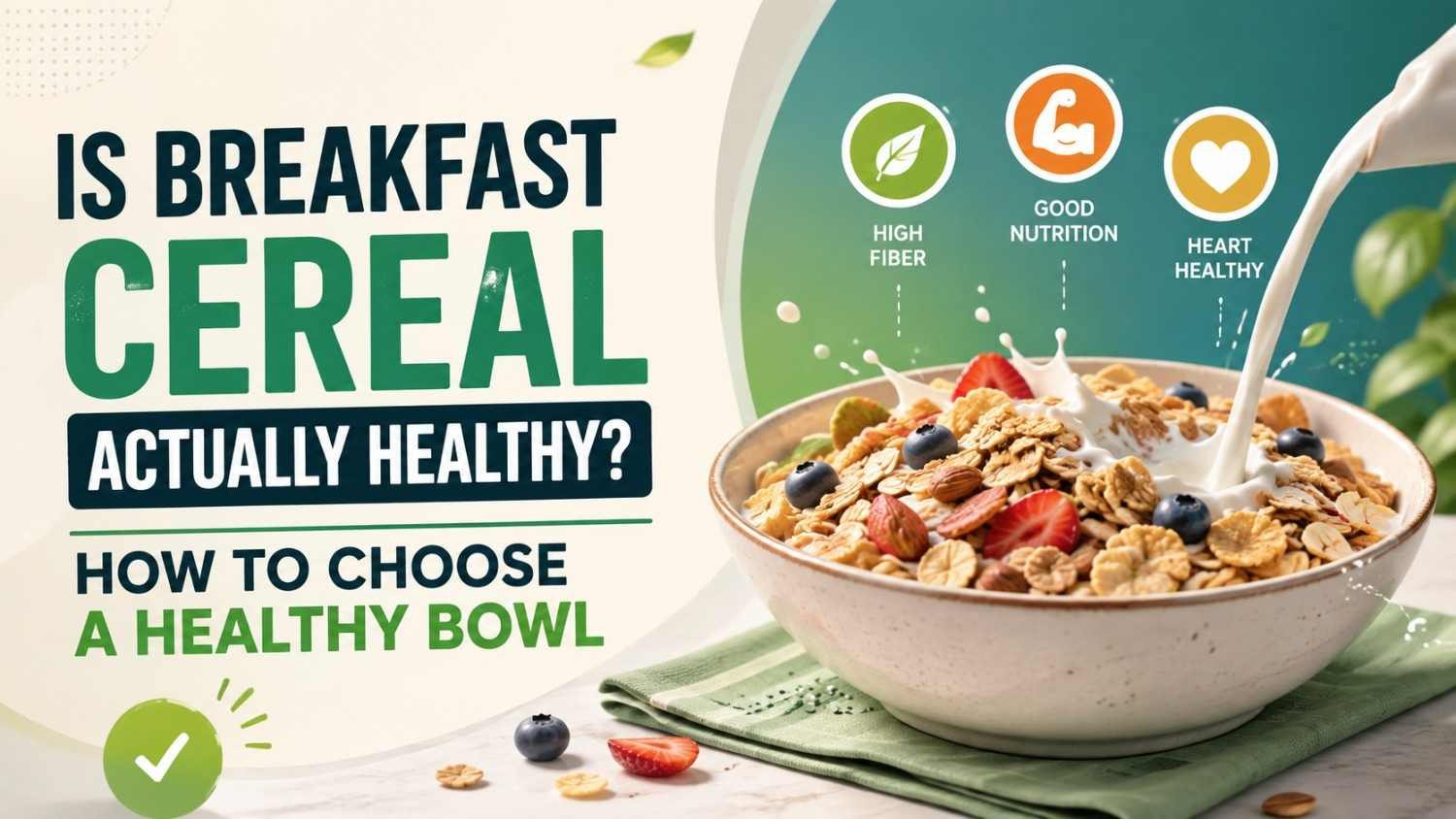
Breakfast cereal has kind of earned this reputation as one of the easiest ways to begin the day. It’s quick, convenient, widely available , and a lot of times the marketing leans hard on claims like whole grains, vitamins, fiber, or heart health. But the front of a cereal box does not always show the whole nutritional story, I mean not exactly. Some cereals that people grab every day can have quite a bit of added sugar, relatively little protein and fiber, and more calories than you would guess once the portion ends up bigger than the serving size that’s printed there. A 2025 study looking at more than 600 breakfast cereals also brought up even more doubts about how good the nutrition is in many of the popular options.
That said, it doesn’t mean you have to stop eating cereal entirely. A smarter route is figuring out what actually separates a healthy breakfast cereal from a product that’s more like sweetened, refined-grain. You can do this by reading the ingredient list, checking fiber and added sugar, taking the serving size seriously, and then pairing the cereal with protein and other nutrient-rich foods. That way breakfast ends up more balanced instead of just “lighter” or “fast” on paper. Harvard Health, for example, suggests looking for whole grain as the first ingredient, decent fiber, little or no added sugar and sodium, reasonable calories, and keeping things like ingredients kind of straightforward and not overly complex.
Is Breakfast Cereal Healthy?
The answer kinda depends on the cereal you pick and, basically how you eat it. Cereal is not automatically unhealthy just because it comes in a box. Whole-grain cereals with useful amounts of fiber and not too much added sugar can fit into a balanced eating pattern. The thing is that a bunch of super advertised products are sweetened and heavily processed, while their packaging may highlight one positive nutrient detail, but not really say much about sugar, calories, sodium, or even the low protein content.
That’s why cereal nutrition facts deserve more attention than colorful packaging or health- related claims, because the glossy stuff can be well, kinda misleading.
Why the Front of the Box Can Be Misleading
Food packaging is kinda designed to grab your attention, like really fast. Phrases such as “natural,” “whole grain,” “high in vitamins,” or “heart healthy” can make you think the item is nutritionally better than it is. But honestly, a health claim doesn’t always share the full nutritional story. Harvard Health points out that researchers have found very little link between the health claims you see on cereal boxes and the cereal’s overall nutritional quality.
So instead of just trusting the marketing vibe, turn the box around and look at the nutrition facts label plus the ingredient list. That small habit can help you choose a more informed breakfast food , not just a prettier one.
Check Whole Grains First
One of the first things you should verify is the first ingredient on the list. A cereal that is mostly made from whole grains can deliver more fiber and helpful nutrients than one built mainly on refined grains. Harvard Health suggests you try to see “whole grain” as the first ingredient when you are picking a cereal.
Also scan for ingredients like whole wheat, whole oats, whole rye, or other clearly identified whole grains. Just seeing “multigrain” by itself doesn’t automatically mean the product is mainly whole grain. Whole grains can also act as useful dietary fiber sources, so the whole grain cereal benefits are worth considering when you compare different brands.
Check the Fiber Content
Fiber is kinda one of the easiest nutritional markers to compare across cereals. Harvard Health’s more recent guidance basically says to aim for at least 2.5 grams of fiber per serving, and like, 5 grams or more is an even better target . Fiber can help with digestive well-being and it’s linked to a bunch of longer-term health perks. Still, many people don’t actually get enough fiber overall. Harvard Health points out that most Americans land far below the recommended fiber intake. So, when you’re comparing two fairly similar cereals, the one with substantially more fiber might offer more nutritional value, in a more practical sense.
Pay Attention to Added Sugar
Sugar is probably one of the biggest reasons some breakfast cereals really deserve a closer look. A cereal can seem “healthy” because it lists vitamins, or it has a small amount of fiber, yet it can also pack in a notable amount of added sugar . If you keep regularly eating foods that are high in added sugar it can make it harder to stick with a nutrient-dense diet, since those calories sort of crowd out room that could go to more wholesome foods. When you’re trying to find a lower sugar breakfast cereal, look at the added sugar section rather than trusting marketing phrases like “lightly sweetened” or “made with natural ingredients”. A cereal with little or no added sugar gives you more sweetness control, and you can always add fruit if you want .
Serving Size Matters More Than You Think
One of the most overlooked parts of cereal nutrition is the serving size kind of thing. A cereal box might show 120 to 150 calories per serving, but that serving can be way smaller than what ends up in your bowl, even if you swear you’re just doing a normal pour. Harvard Health points out that actual portions can end up going over 300 calories for some people, even though the label says a much smaller serving. If you regularly pour cereal without measuring, try measuring your usual portion just once. You might realize, oh, your bowl holds significantly more than one listed serving. That’s why cereal portion control becomes this real part of figuring out whether a cereal matches your nutritional targets, not just whatever number is printed on the front.
Don’t Focus Only on Calories
Calories are important, but they shouldn’t be the only lens. Two cereals can land at a similar calorie count, yet still deliver very different amounts of fiber, protein, added sugar, and micronutrients. A nutrient-dense cereal can give more overall nutritional payoff for those calories than a highly sweetened refined-grain cereal. So yeah, think of calories as a piece of the whole story rather than the entire story, because it really isn’t just about the calories.
Protein Can Make Breakfast More Balanced
Many ready-to-eat cereals do not provide much protein by themselves. That does not necessarily make them a poor food choice, but it means the rest of the meal matters. Adding a protein-rich food can create a more balanced breakfast.
Depending on your dietary preferences, you could pair cereal with:
- Greek yogurt.
- Milk or a protein-fortified milk alternative.
- Nuts or seeds.
- A side of eggs.
- Nut or seed butter.
Harvard Health similarly recommends combining carbohydrates containing fiber with protein and healthy fats as part of a balanced breakfast.
Add Fresh Fruit Instead of More Sugar
If you lean toward sweeter cereal, adding fresh or frozen fruit can be, I mean, a pretty useful little trick. Bananas , berries, apples, peaches, or other fruits can bring natural sweetness along with fiber and other nutrients. This really helps especially when you’re moving from a very sweetened cereal to a lower-sugar one. Instead of expecting the cereal itself to do all the sweet work, you can customize the meal. A straightforward blend of high fiber breakfast ideas, fruit, and a protein rich milk or yogurt can feel much more balanced than a big bowl of sugary cereal by itself.
Don’t Be Fooled by Added Vitamins
Some cereals are fortified with vitamins and minerals , and sure, that can be helpful. But the fortification part doesn’t automatically mean an otherwise highly processed, sugar heavy product becomes nutrient dense in any real sense.
Harvard Health points out that some widely known cereals add vitamins but may still carry substantial amounts of sugar, sodium, or other less desirable traits. So don’t just grab one because you saw a vitamin at a high percentage of the Daily Value, check the entire nutrition profile, start to finish.
What About Artificial Colors and Additives?
Ingredients can feel kind of intimidating, especially when a cereal has those unfamiliar names, and you’re just trying to figure out what you’re actually eating. In a recent piece, Harvard Health says it helps to pick cereals with shorter ingredient lists that use familiar, recognizable food items. And it also points out that simply removing artificial colors or flavors, by itself, doesn’t automatically mean the cereal is nutrient-dense, so it’s more nuanced than that.
In the bigger picture, it’s not enough to just look for “less stuff” on the label. Like, a cereal might have fewer additives but still include a lot of added sugar, and that doesn’t automatically make it a better choice than a different product just because the ingredient list looks more familiar. Instead, start with the essentials: whole grains, fiber, added sugar, sodium, calories, protein, and also portion size.
Is Oatmeal Better Than Cereal?
Oatmeal can be a great breakfast, but it doesn’t have to become a total replacement for cereal, either. Plain oats let you manage the sugar amount and what you top your bowl with. You can mix them with fruit, nuts, seeds, yogurt, or milk, and that can bring in extra nutrients.
Still, the “best” breakfast is the one that actually matches your preferences and how your days work. If cereal is fast and convenient enough to help you keep eating breakfast regularly, then picking a better cereal and upgrading what you add to it may be more realistic than quitting it completely.
Better Alternatives to Sugary Cereal
If your current cereal is really high in sugar and kind of low in fiber, you have a few options. Like you could grab plain or just lightly sweetened whole grain cereal , or even oatmeal, unsweetened muesli, whole grain toast, eggs, yogurt with fruit, and other breakfast ideas that are less touched by processing.
Harvard Health also brings up oatmeal with fruit and nuts, eggs, yogurt with fruit and peanut butter on whole grain toast as swap ideas, instead of those super sweet cereals. The point isn’t to hunt down one “perfect” breakfast. It’s more about building a morning meal that still gives you helpful nutrition , without depending too much on extra added sugar.
A Simple Cereal Shopping Checklist
You do not need to memorize complicated nutritional rules every time you visit the supermarket.
Turn the box around and check these features:
- Whole grain appears as the first ingredient.
- Fiber is at least 2.5 grams per serving, with 5 grams or more preferable.
- Added sugar is minimal or absent.
- Sodium is reasonably low.
- Calories fit your needs.
- The ingredient list is relatively straightforward.
- The serving size reflects a realistic portion.
These points closely reflect Harvard Health’s recent guidance for selecting healthier cereals.
The 10-to-1 Fiber-to-Carbohydrate Rule
Another useful tool for checking whole-grain products is that 10-to-1 ratio thing. Harvard researchers suggested you try to spot about one gram of fiber for every 10 grams of carbohydrate, kinda like a quick benchmark when you’re looking at grain products. In the study the Harvard Health team talked about, foods that met this kind of ratio generally ended up with less sugar, lower sodium, and less trans fat. Of course, it’s not some strict rule where every cereal has to hit the number, but it can still be a handy comparison device when a few products seem pretty similar at first glance.
Think About the Entire Breakfast
A bowl of cereal doesn’t really exist by itself. What you pour in, what you place on top, and what you eat along with it can shift the nutritional picture of your morning pretty a lot.
For instance, one bowl of low-sugar, whole-grain cereal plus high-protein milk, berries, and a modest amount of nuts is basically a different situation than a bigger bowl of highly sweetened cereal eaten straight up. That’s why putting together a balanced breakfast around cereal can end up being more helpful than just asking, on its own, whether cereal is healthy or not.
What the Recent Research Suggests
The concerns around cereal are, well, not limited to the older products. A study published in 2025 looked at about 1,200 ready-to-eat cereals marketed to children, new or reformulated somewhere between 2010 and 2023. Harvard Health reported that the study found increasing amounts of fat, sodium, and sugar, at the same time protein and fiber went down.
Meanwhile, there are efforts happening to improve the nutritional standards for cereals served through school breakfast programs including gradual reductions in sugar and salt, and also higher whole-grain requirements. All that said these findings seem to point to something fairly basic, consumers really shouldn’t just assume newer versions are automatically healthier.
What About Children?
Children are among the most heavily targeted groups when it comes to breakfast cereal. The bright packaging, the characters, sweet flavors, and the promotional claims can make very processed cereals feel extra desirable. Harvard Health also mentions that more than a quarter of US children and adolescents eat ready-to-eat cereal for breakfast most days of the week.
So for parents, the best move is not always to ban cereal outright. A more realistic approach is to help children learn about balanced portions and then pair cereal with fruit and foods that bring protein. And if you choose a lower-sugar cereal, it can be made more enjoyable by adding fresh fruit, rather than picking a product that already carries a big amount of added sugar.
Common Mistakes When Choosing Cereal
Many shoppers make the same mistakes because cereal packaging is designed to emphasize positive features.
Watch out for:
- Choosing cereal only because it says “whole grain.”
- Ignoring added sugar.
- Assuming fortified means healthy.
- Eating several servings without realizing it.
- Focusing only on calories.
- Treating “natural” as a guarantee of nutritional quality.
- Ignoring fiber.
- Assuming a familiar brand is automatically a good choice.
Reading the label takes only a minute but can dramatically improve your ability to compare products.
A Better Way to Eat Cereal
You do not have to make breakfast complicated. Just start with a cereal that has whole grains and real, meaningful fiber. Go for one with low added sugar and a calorie number that feels reasonable, not too high. Also, measure your portion now and then, so you get a clear idea of what you are really eating, not just what the bowl “looks like” filled.
After that, add foods that make the whole meal feel better, like fruit, nuts, seeds, yogurt, or a protein-rich milk alternative. This makes it more filling and more nutrient conscious without pushing you to completely redo your morning routine, or anything like that.
Conclusion
Breakfast cereal is not automatically healthy, and it is not automatically unhealthy either. How good it is comes down to the ingredients, how much added sugar you get, your fiber level, your protein, the serving size, and what you end up pairing it with. Recent research and Harvard Health guidance say to be especially careful with cereals that are heavily sweetened, but end up offering little fiber or protein even if the packaging sounds promising. The easiest method is to look past the front of the box, then compare what’s on the nutrition label and the ingredient list. Choose whole grains, aim for higher fiber, keep added sugar and sodium limited, watch realistic portions, and add fruit plus protein when it makes sense. With these simple habits, cereal can stay as a convenient part of a balanced breakfast, instead of something you feel you have to fully avoid.
Frequently Asked Questions
1. Is breakfast cereal healthy every day?
It can be, depending on the cereal and the overall meal. Choose products with whole grains, useful fiber, minimal added sugar, and reasonable portions.
2. What should I look for in a healthy cereal?
Look for whole grain as the first ingredient, at least 2.5 grams of fiber per serving, preferably around 5 grams or more, minimal added sugar and sodium, and a reasonable serving size.
3. Is high-fiber cereal better than sugary cereal?
Generally, a cereal providing more fiber and less added sugar is a more nutritious choice than a highly sweetened cereal with little fiber.
4. How can I make cereal healthier?
Choose a lower-sugar whole-grain cereal and add fruit, nuts, seeds, or a protein-rich milk or yogurt to create a more balanced breakfast.
5. Should I stop eating breakfast cereal?
Not necessarily. If you enjoy cereal, choose a nutritionally stronger option and pay attention to portions rather than assuming all cereal is unhealthy.